
Use-Case Comparison Guide
Best Albato Alternatives in 2026: Which Automation Tool Fits Your Workflow?
Albato is a credible choice for straightforward no-code automation, but it is not the best fit for every workflow. The alternatives below are organized by the reason you might leave Albato: more complexity, broader app coverage, technical control, higher-volume economics or open-source AI automation.
Pricing and product information checked September 10, 2026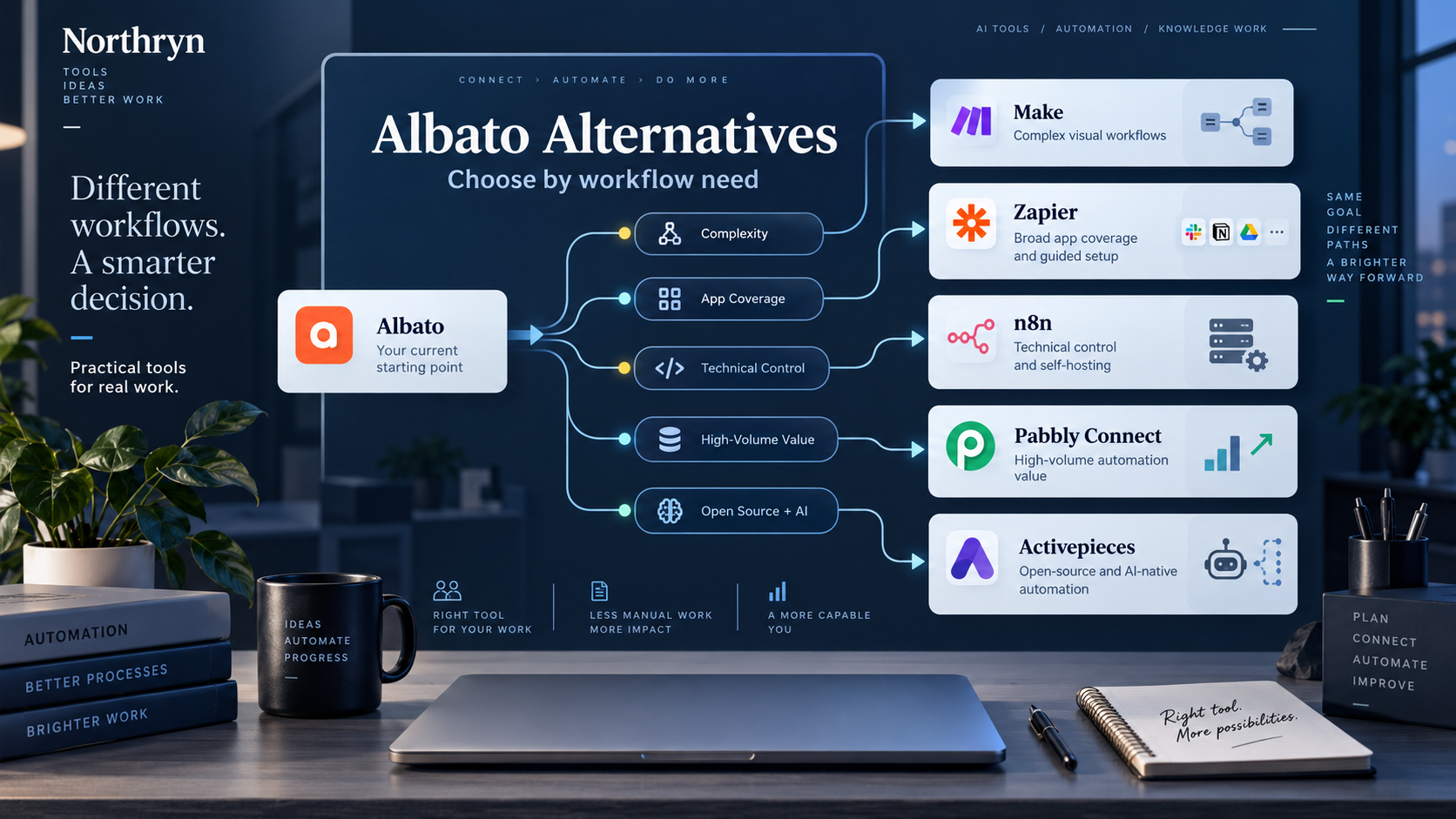
Quick Answer
The best Albato alternative depends on why Albato no longer fits
Choose Make for more complex visual workflows, Zapier for broader app coverage and guided setup, n8n for technical control, Pabbly Connect for task-heavy economics, and Activepieces for open-source AI-first automation. Stay with Albato if your workflows are direct, easy to reason about and your transaction usage is predictable.
Choose by the reason you are leaving Albato
This is more useful than ranking five tools from “best” to “worst.” Each one solves a different problem.
Best when scenarios need routers, deeper branching and stronger execution visibility.
Best when app availability and guided onboarding matter more than visual depth.
Best for builders who want execution-based pricing, self-hosting and custom logic.
Best when higher task volume and free internal operations materially affect cost.
Best for AI-native automation with one-credit-per-run pricing and open-source roots.
Albato alternatives at a glance
Instead of comparing incompatible usage units in one dense table, use these decision lanes to see which tool fits each type of requirement.
Albato
Best for: straightforward trigger → condition → action workflows with predictable transaction usage.
Make
Best for: more visual workflows, branching, routers and deeper execution control.
Zapier
Best for: broad app coverage, guided setup and fast onboarding.
n8n
Best for: technical users who want execution-based pricing, custom logic and self-hosting.
Pabbly Connect
Best for: task-heavy workflows where free internal steps can materially improve economics.
Activepieces
Best for: open-source, AI-oriented workflows and one-credit-per-run pricing.
Albato
Less compelling once workflows need deep branching, advanced debugging or broader execution visibility.
Make / Zapier
Make brings more complexity; Zapier can become expensive as task volume rises.
n8n / Pabbly / Activepieces
n8n requires more technical confidence; Pabbly and Activepieces have different ecosystem and UX trade-offs.
1. Make — best for workflows likely to grow in complexity
Make is the strongest alternative when Albato starts to feel too linear for the scenario you are building.
Make
Northryn hands-on testedNorthryn’s testing found Make stronger when the workflow is likely to gain more branches, filters and execution logic over time. Its visual-first scenario builder exposes the structure of the automation more clearly than Albato once complexity increases.
The Free plan currently includes 1,000 credits per month, while the platform lists more than 3,000 apps and includes routers and filters even at the free level.
Why switch
- Stronger visual workflow control
- More headroom for branching
- 3,000+ apps officially listed
Why not
- More to learn
- Can feel excessive for simple automations
- Usage accounting differs from Albato
2. Zapier — best for broad app coverage and guided setup
Zapier remains the practical alternative when ecosystem breadth and onboarding simplicity matter more than visual scenario depth.
Zapier
Northryn hands-on testedIn Northryn’s comparable Google Sheets testing, Zapier felt guided and easy to follow. The current Free plan includes 100 tasks per month, while Professional starts at $19.99/month and adds multi-step Zaps, premium apps and webhooks.
Zapier is especially useful when the deciding factor is whether a less-common app or integration is available inside a familiar automation ecosystem.
3. n8n — best for technical control and self-hosting
n8n is the better alternative when the user is comfortable with a more technical system and wants fewer constraints around workflow architecture.
n8n
Official informationn8n prices its hosted plans by workflow executions rather than by individual steps. Starter currently costs €20/month billed annually for 2.5K workflow executions, while Pro is €50/month for 10K executions. Both allow unlimited steps.
This model can be attractive for technically complex workflows because one execution can contain many steps without each step becoming a separate usage unit.
4. Pabbly Connect — best for task-heavy automation economics
Pabbly deserves a place when cost per task is a major constraint and you run workflows with many internal logic steps.
Pabbly Connect
Northryn hands-on testedPabbly’s current Standard offer lists 10,000 tasks per month at $16/month on the official pricing page. It also says internal operations such as Filter, Router and Formatter do not count as tasks.
That accounting model can materially change economics for workflows with a lot of internal logic, even when the headline plan price is not directly comparable with Albato.
5. Activepieces — best for open-source, AI-native automation
Activepieces is the most interesting alternative for users who want an open-source foundation without giving up a managed cloud option.
Activepieces
Official informationActivepieces currently offers a Free plan with 100 credits per day and a Plus plan at $16/month billed yearly with 10,000 credits per month. Its pricing model is unusual: one credit covers an entire flow run, regardless of the number of steps.
It also includes flows, agents, tables and AI-oriented features across its current plans, making it a more AI-native alternative than a traditional app-to-app automation tool.
When Albato is still the better choice
An alternatives article should not imply that switching is always an improvement.
Stay with Albato when:
- Your workflows are straightforward
- You value a clear trigger → condition → action structure
- Your transaction volume is predictable
- You do not need deep visual branching
- The integrations you need already exist
Switch when:
- Workflow complexity keeps increasing
- You need a specific missing integration
- Self-hosting or custom code becomes important
- Task economics dominate the decision
- Your AI automation requirements go beyond Albato’s current tested fit
Final Recommendation
Switch tools only when you can name the limitation you are trying to solve
Make is the strongest upgrade path for workflow complexity. Zapier is the safer choice for ecosystem breadth. n8n is better for technical control, Pabbly for task-heavy economics, and Activepieces for open-source AI-first automation.
If none of those problems apply to you, Albato may still be the more efficient tool because its simpler workflow structure is easier to operate and maintain.
Frequently Asked Questions
What is the best Albato alternative?
Make is the best alternative for users who need more complex visual workflows. Zapier is better for ecosystem breadth, n8n for technical control, Pabbly Connect for task-heavy pricing and Activepieces for open-source AI automation.
Is Make better than Albato?
Make is stronger when workflows need more branching, visual execution detail and complexity headroom. Albato can be easier to operate for straightforward trigger → condition → action workflows.
Is Zapier better than Albato?
Zapier is generally the better fit when broad app coverage and guided onboarding matter most. Albato may offer a simpler workflow experience and a different transaction-based pricing model.
Is n8n cheaper than Albato?
There is no universal answer because n8n prices hosted plans by workflow executions while Albato uses transactions. n8n can be attractive for complex multi-step workflows because each execution can contain unlimited steps.
Which Albato alternative is best for high-volume automation?
Pabbly Connect is worth evaluating when task volume dominates the economics because internal steps such as Filter, Router and Formatter are not counted as tasks under its current model. Always model the same workflow before comparing cost.
Should I leave Albato?
Only if you can identify a specific limitation such as workflow complexity, integration coverage, technical control, pricing at your actual usage level or collaboration requirements. If Albato already handles your workflows reliably, switching may create more work than value.