
Hands-on AI research comparison
SciSpace vs Elicit: Which Is Better for Research and Literature Reviews?
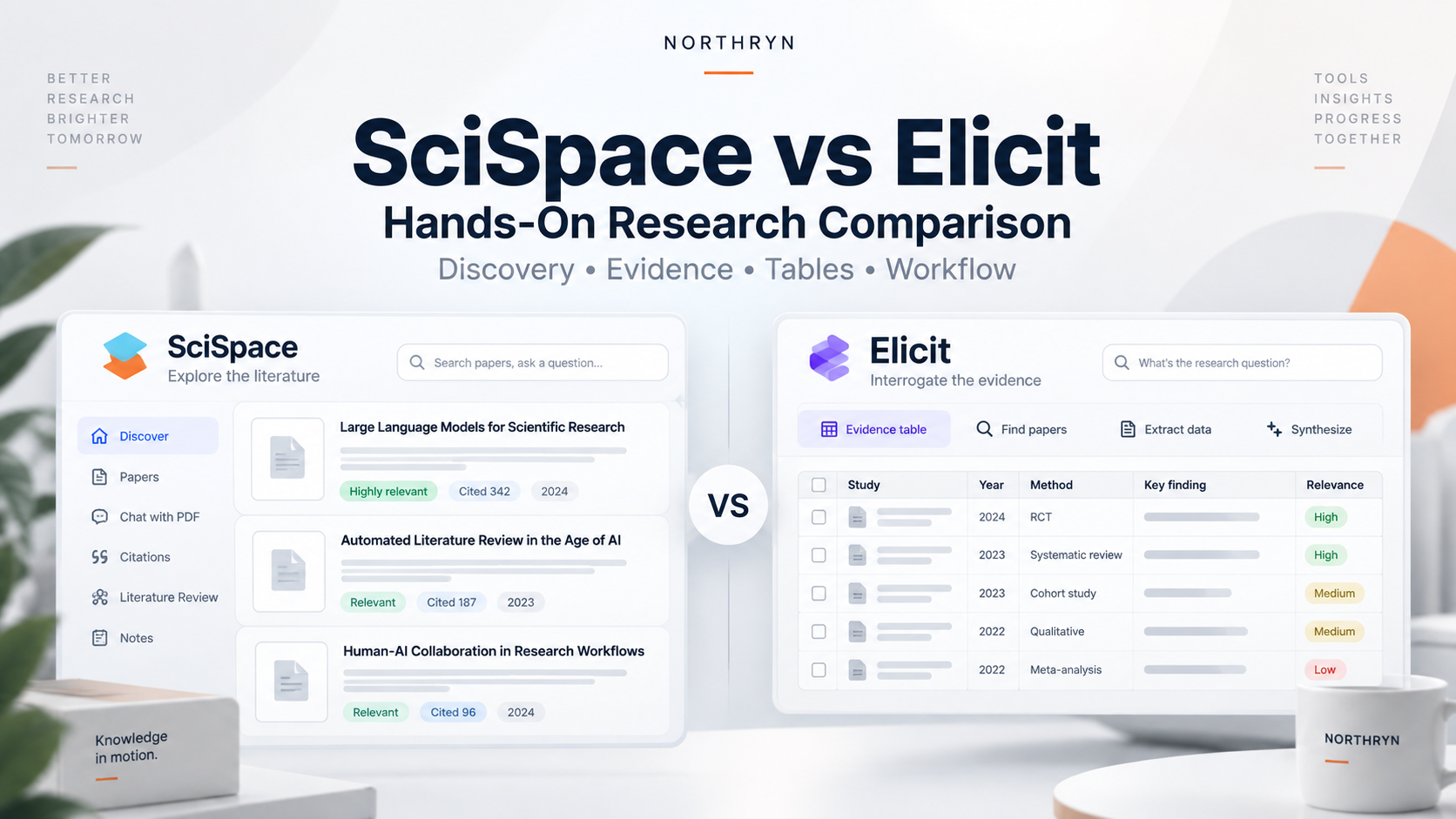
SciSpace and Elicit can both search academic literature, synthesize research and build structured evidence tables, but our hands-on testing showed a meaningful difference in emphasis. SciSpace was stronger for broad scholarly discovery and paper-level exploration, while Elicit was stronger for structured evidence review, counterevidence and reusable research tables.
Affiliate disclosure: This comparison contains affiliate links to SciSpace. Northryn may earn a commission if you subscribe through them, at no extra cost to you. Elicit is not currently an affiliate partner. Affiliate availability does not determine the conclusions below.
How this comparison was prepared: Northryn tested SciSpace and Elicit using the same broad research question and compared scholarly discovery, synthesis, counterevidence, structured extraction, evidence tables, enrichment and export behaviour. Product pricing and plan limits are treated separately as official vendor information.
Quick verdict
SciSpace is better for exploring the literature. Elicit is better for structuring and interrogating the evidence.
There is no universal winner. In our test, SciSpace searched more broadly across scholarly sources and gave us a richer environment for moving from discovery into individual papers. Elicit was more deliberate about challenging its own synthesis, finding counterevidence and turning the research problem into a reusable structured dataset.
Choose SciSpace if you want to explore
Better suited to broad literature discovery, paper-level exploration, citation-grounded synthesis and workflows that move from searching into reading and working with academic papers.
Choose Elicit if you want to interrogate
Better suited to structured evidence synthesis, adversarial review, extraction, evidence tables and research outputs you intend to inspect or reuse later.
SciSpace vs Elicit at a Glance
Both tools handled the same research problem successfully. The most useful differences appeared in how they searched, challenged and structured the evidence.
Swipe horizontally to compare all columns →
| Decision factor | SciSpace | Elicit | Better fit |
|---|---|---|---|
| Scholarly discovery | Broader multi-source first pass in our test | More focused initial research set | SciSpace |
| Initial synthesis | Citation-grounded narrative synthesis | Direct multi-study evidence synthesis | Tie |
| Counterevidence | Balanced evidence possible through follow-up prompting | Independent Review explicitly challenged the initial answer | Elicit |
| Evidence tables | Structured paper tables with relevance context | Highly reusable evidence-oriented tables | Slight Elicit |
| Structured extraction | Can iteratively enrich paper tables | Strong extraction and enrichment workflow | Elicit |
| Export in our test | Papertable download required an upgrade | Structured Excel export succeeded | Elicit |
| Paper-level exploration | Strong relevance scores, reasoning and source context | More evidence-synthesis oriented | SciSpace |
| Overall workflow breadth | Discovery → papers → synthesis environment | Evidence review → extraction → reusable structure | SciSpace |
What Northryn Actually Tested
We deliberately used one broad question in both tools rather than testing them with unrelated prompts.
The same research question in both platforms
“How does generative AI affect productivity in knowledge workers?”
From there, we examined literature discovery, synthesis, counterevidence, structured evidence tables, metadata enrichment, traceability and export or reuse behaviour.
Research Discovery: SciSpace Searched More Broadly
The clearest SciSpace advantage appeared before we even began refining the evidence.
SciSpace
A wider scholarly first pass
SciSpace searched across SciSpace, SciSpace Full Text, Google Scholar and arXiv during our test. The combined research process produced 90 retrieved records and retained 41 highly relevant studies after deduplication and AI-based reranking.
Its final synthesis was then generated from the top-ranked papers, with linked references, DOI information and paper-level sourcing visible around the workflow.
Elicit
A narrower but more synthesis-led start
Elicit’s initial Research Agent answer synthesized evidence across 12 sources. Instead of presenting the search primarily as a paper discovery exercise, it moved quickly toward a direct answer comparing empirical results across knowledge-work tasks.
That made Elicit immediately useful for answering the research question, but its first-pass corpus was less broad than SciSpace’s in this particular test.
Evidence Synthesis and Verification: Elicit Challenged Its Own Answer
Both tools synthesized the literature. Elicit’s strongest differentiator appeared when we asked it to review its own reasoning.
SciSpace produced a useful cited synthesis
SciSpace summarized productivity and task performance, worker heterogeneity, limitations, risks, human oversight and workflow fit. Its answer remained anchored to individual papers and visible references.
It was a strong literature-oriented synthesis, particularly if the next step is to inspect the underlying papers.
Elicit actively tried to falsify its first conclusion
Elicit’s Independent Review identified selection-bias risk, noted the absence of an explicit null or harm search and recommended an adversarial evidence pass.
It expanded the evidence base from 12 to 39 sources and deliberately searched for null results, slowdowns, quality declines, maintenance burdens and critiques of average task-speed metrics.
Structured Extraction and Evidence Tables
This was closer than the discovery comparison. Both platforms could turn the research question into structured evidence rather than only narrative prose.
SciSpace
Paper tables retain discovery context
SciSpace built a balanced evidence table and classified studies as Positive, Mixed, Negative or Unclear.
The table retained study context, caveats, relevance scores, relevance tags, reasoning, source information and bibliographic context. We then asked it to add SampleSize, PublicationStatus and OutcomeDefinitions, which it did while preserving missing information as “Not available in metadata”.
Elicit
Evidence tables feel closer to a research dataset
Elicit created a nine-row balanced evidence table covering positive, heterogeneous, mixed, negative and cautionary findings.
It then enriched the same table with sample size, publication status and outcome definitions while explicitly acknowledging information that could not be established from the available sources.
Export and Reuse: Elicit Was Better in Our Tested Workflow
A structured table becomes much more useful when it can leave the platform and become part of the rest of your research process.
Elicit exported a reusable Excel dataset
Our Elicit table exported successfully to Excel with 16 structured columns, including Title, Authors, URL, DOI, Design, Evidence Class, Interpretation, Key Caveat, Outcome Definition, Productivity Result, Publication Status, Sample Size and Summary.
That made the output immediately reusable for further analysis, documentation or manual review.
SciSpace hit an export barrier in the tested account
SciSpace successfully created and enriched its papertable, but the account used for Northryn testing required a paid upgrade when we attempted to download the table.
This is an observation from the tested account, not a claim that every SciSpace export always requires payment.
Pricing and Plan Limits
Pricing matters here because several of the features most useful in a serious research workflow depend on plan limits, credits or export access.
SciSpace
Lower paid entry point
Free, or Premium from $12/month billed annually
- Basic: $0 with 100 Agent credits/month
- Premium: 1,200 Agent credits/month
- Premium: $12/month annual or $20 monthly
- Advanced: 10,000 Agent credits/month
- Max: 40,000 Agent credits/month
Elicit
Evidence workflows scale through paid tiers
Basic Free, Plus from $11/user/month billed annually
- Basic: Free
- Plus: $11/user/month billed annually
- Pro: $39/user/month billed annually
- Scale: $89/user/month billed annually
- Pro includes the dedicated Systematic Review Workflow
Who Should Choose SciSpace or Elicit?
The decision becomes much easier when you start with the research job rather than the feature list.
Choose SciSpace
Best for broader literature exploration
- You need to discover a broad set of academic papers.
- You want to inspect individual papers and their context.
- You value visible relevance scoring and paper-level reasoning.
- You want discovery, reading and synthesis in one environment.
- You regularly move between literature search and individual papers.
Choose Elicit
Best for structured evidence review
- You need evidence tables rather than only narrative answers.
- You want the system to challenge an initial conclusion.
- You need counterevidence and methodological caveats surfaced explicitly.
- You want to enrich extracted study metadata iteratively.
- You expect to reuse the structured research outside the platform.
Final recommendation
SciSpace for exploring the literature. Elicit for structuring and challenging the evidence.
Our testing does not support declaring one platform universally better. SciSpace gave us the stronger discovery and paper-exploration environment. Elicit gave us the stronger workflow for questioning conclusions, structuring studies and turning evidence into a reusable dataset.
For many researchers, the deciding question is simple: do you need to find and work through the literature, or do you need to organize and interrogate the evidence?
Frequently Asked Questions
Is SciSpace better than Elicit?
Not universally. In Northryn’s hands-on test, SciSpace was stronger for broad scholarly discovery and paper-level exploration. Elicit was stronger for structured evidence synthesis, counterevidence and reusable research tables.
Is Elicit better for systematic literature reviews?
Elicit is particularly well suited to structured evidence-review workflows, and its paid plans include dedicated systematic-review functionality. However, the best choice depends on whether your priority is structured screening and extraction or broader literature discovery.
Which tool is better for finding research papers?
SciSpace was stronger in our test. It searched across multiple scholarly sources and produced a substantially broader first-pass research set.
Which tool is better for evidence tables?
Both successfully created and enriched structured evidence tables. Elicit had a slight advantage in our workflow because the table felt more directly designed for evidence review and exported successfully as a reusable Excel dataset.
Can SciSpace export evidence tables?
SciSpace created the evidence table successfully in our test, but the account used by Northryn required a paid upgrade when we attempted to download the papertable. That observation should not be generalized to every account, plan or export type.
Can SciSpace and Elicit replace manual source checking?
No. Both can accelerate discovery, synthesis and extraction, but AI-generated interpretations should still be checked against the underlying papers when accuracy matters.