
Hands-On Review
SciSpace Review: Is It Worth It for Research Papers and Literature Reviews?
SciSpace is most useful when academic papers are a recurring part of your work. Its value comes from bringing literature search, paper reading, evidence extraction and research writing into one research-focused environment rather than acting as another generic PDF summarizer.
Product information verified September 8, 2026Quick Verdict
SciSpace is a strong fit for recurring academic research, but unnecessary for occasional paper summaries
If your work repeatedly moves from finding papers to understanding methods, comparing evidence and producing research-backed output, SciSpace can reduce a meaningful amount of context switching. If you only need to summarize a paper occasionally, a general AI assistant plus careful source checking may already be enough.
Who should use SciSpace?
The decision is less about whether SciSpace has useful features and more about whether academic literature is important enough in your workflow to justify a specialist research environment.
Good fit
- Researchers and students working regularly with scientific literature.
- Analysts, consultants and writers who need evidence-backed reports.
- Independent researchers conducting literature reviews.
- Professionals who repeatedly need to understand papers outside their main field.
Probably skip it
- You only summarize an occasional PDF.
- Your research is mostly news, company information or general web research.
- Your current general-purpose AI workflow already handles paper reading well.
- You expect an AI research tool to replace checking the original evidence.
What Northryn actually tested
The original Northryn review focused on the SciSpace research interface, paper interaction and related-paper discovery. Those screenshots remain useful evidence of the tested workflow, but they should not be treated as proof that every current SciSpace feature was tested hands-on.
Northryn directly reviewed the SciSpace interface and captured the working environment shown below.
Related-paper recommendations were observed and captured during the original review.
Newer tools such as SciSpace Agent, expanded Literature Review workflows and current credit limits are verified from SciSpace’s official 2026 information.
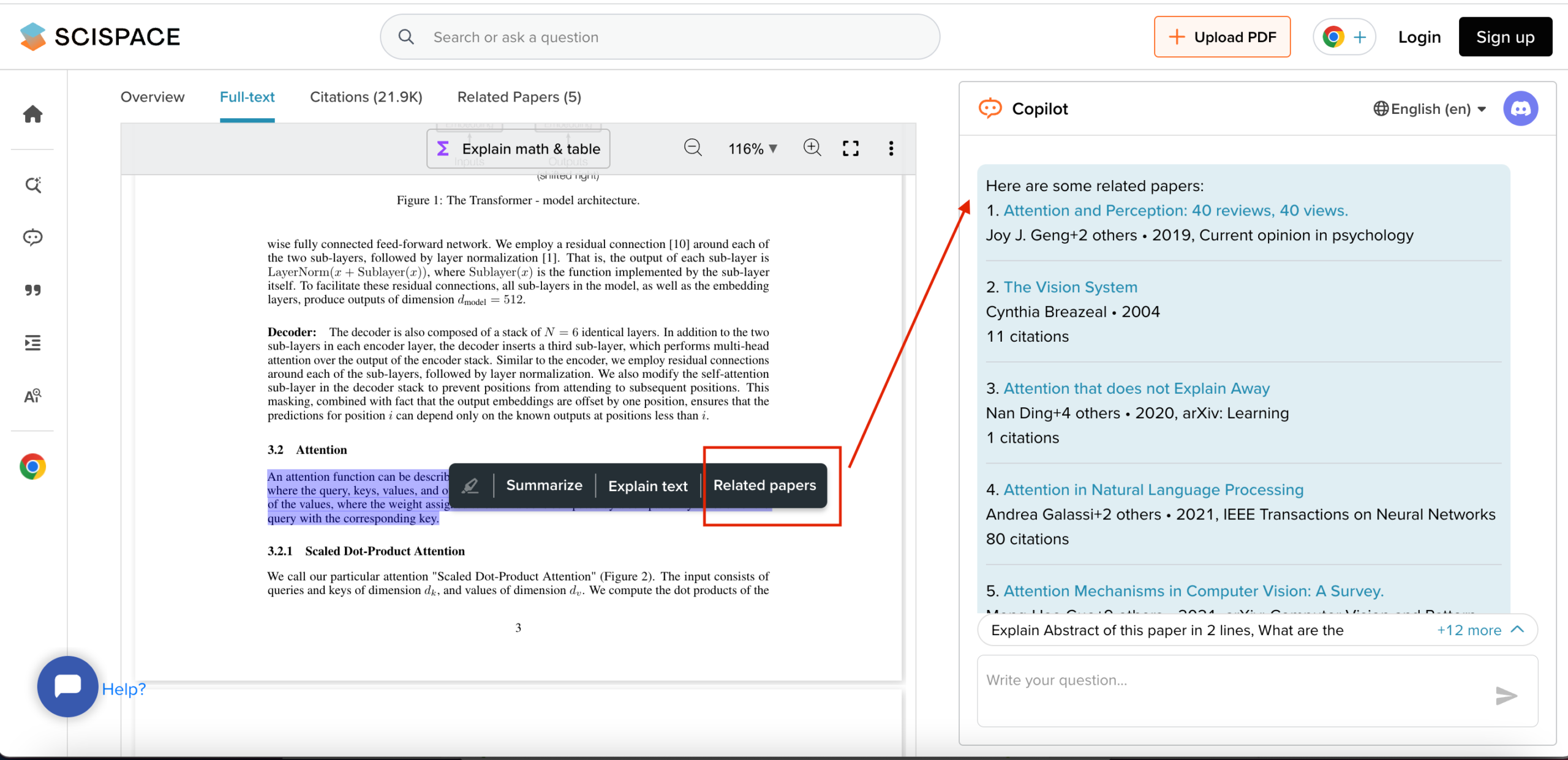
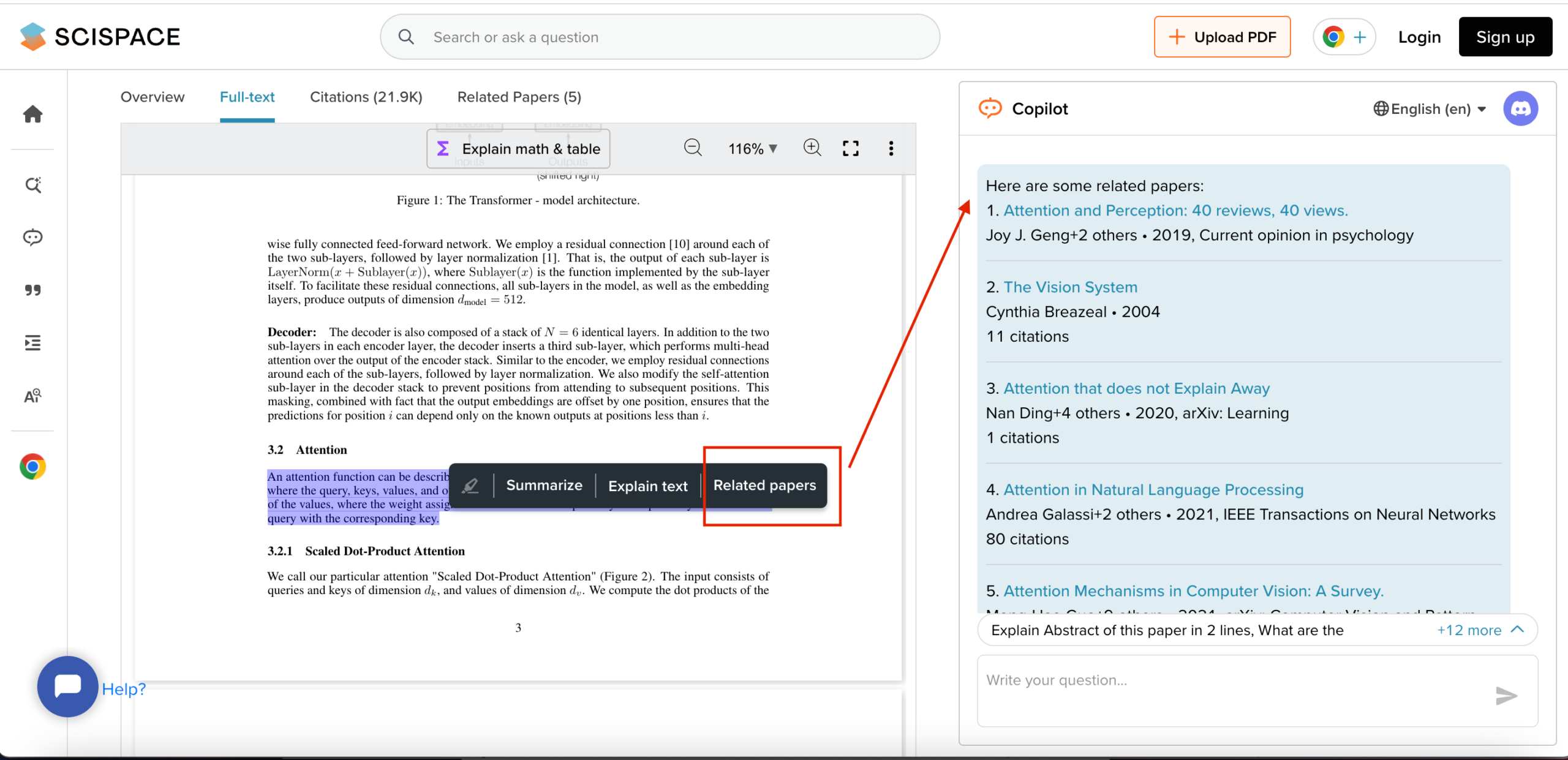
Northryn can responsibly make hands-on claims about the workflow captured above. Current Agent, Deep Review and expanded systematic-review capabilities are useful to discuss, but they are treated here as official product information unless separately tested.
What SciSpace does well
For a buying decision, three parts of the platform matter more than a long feature checklist.
1. Literature discovery
SciSpace’s Literature Review workflow is built around academic search rather than general web results. It supports paper discovery, filtering and review-oriented research, making it more useful when the source set itself is part of the problem.
2. Working inside papers
Chat with PDF is useful when the bottleneck is understanding dense research. Targeted questions about methodology, findings and limitations are generally more valuable than asking for one generic summary.
3. Moving across multiple papers
Current SciSpace tools extend beyond single-document reading into literature review, structured extraction and deeper multi-paper analysis. This is where a specialist research platform can justify itself over a simple PDF chat tool.
4. Where it still needs human judgment
Relevance is not the same as evidence quality. Study design, applicability, contradictory findings and source limitations still need direct evaluation against the original papers.
How SciSpace fits into a research workflow
SciSpace makes the most sense when used as part of a sequence rather than as a collection of disconnected AI features.
Start with a clear research question before searching.
Find relevant papers and narrow the source set.
Question promising papers about methods, findings and limitations.
Organize evidence across multiple studies instead of collecting isolated summaries.
Return to the original papers for evidence that affects the conclusion.
Move verified findings into a report, article, review or decision.
SciSpace should reduce the friction between discovering research and understanding it. It should not become the point where your own evaluation of the evidence ends.
SciSpace pricing and Agent credits
SciSpace now separates its broader research tools from the credit-based SciSpace Agent. According to SciSpace’s current documentation, Agent credits are consumed by Agent tasks, while standalone tools such as Literature Review, AI Writer, Paraphraser, Citation Generator and Notebook remain available independently of that Agent credit balance.
| Plan | Current price | Monthly Agent credits | Best fit |
|---|---|---|---|
| Free / Basic | $0 | 100 | Testing the workflow before paying |
| Premium | $12/mo billed annually or $20 monthly | 1,200 | Regular individual research |
| Advanced | $70/mo billed annually or $90 monthly | 10,000 | Heavier Agent-assisted research |
| Max | $160/mo billed annually or $200 monthly | 40,000 | High-volume Agent usage |
Do not upgrade because a higher tier looks more complete. First test SciSpace with real papers and identify whether your bottleneck is literature discovery, paper understanding, multi-paper synthesis or Agent automation. Then choose the capacity that matches the work you actually do.
SciSpace pros and cons
Pros
- Purpose-built around academic literature rather than general AI chat.
- Combines discovery, paper interaction and broader literature-review workflows.
- Useful when dense papers repeatedly create reading friction.
- Can reduce context switching between finding, reading and organizing research.
- Free access lets you test the workflow before paying.
Cons
- AI-generated explanations and synthesis still require source verification.
- Agent credits can disappear quickly during complex multi-step research tasks.
- Occasional users may not need a specialist research platform.
- General web research is outside SciSpace’s strongest use case.
- Systematic-review tooling cannot replace a defensible research methodology.
SciSpace alternatives
The strongest alternative depends on which part of the research workflow you are trying to improve.
Structured evidence synthesis
Elicit
Explore workflow fit
Worth considering when systematic evidence search, screening, extraction and structured synthesis are the center of the job. Compare SciSpace vs Elicit →
Current web researchPerplexity
Explore workflow fit
Better suited when the research problem extends beyond academic papers into recent web information and broader source discovery.
Research questionsConsensus
Explore workflow fit
Useful when you want to begin with a question and quickly explore what published academic evidence says about it.
General knowledge workChatGPT or Claude
Explore workflow fit
More flexible for planning, synthesis, drafting and general document work, but less specialized around academic literature workflows.
Final Verdict
SciSpace is worth testing when academic literature is a recurring workflow, not an occasional input
Many AI tools can summarize a PDF. SciSpace is more compelling because it connects several parts of academic research: discovering papers, working inside them, comparing literature and moving toward research-backed output.
That specialization is also the reason not everyone needs it. If you only read a few papers occasionally, keep your workflow simpler. If research papers repeatedly feed into reports, articles, analysis or decisions, SciSpace is a credible specialist platform to test.
Sources and methodology
- Hands-on evidence: Northryn’s original SciSpace review and the screenshots retained above.
- Official product information: SciSpace Pricing, SciSpace Help Center, Literature Review documentation and SciSpace Agent credit documentation, checked September 8, 2026.
- Editorial inference: Recommendations about workflow fit, when to pay and which users should skip SciSpace are Northryn’s interpretation of the tested evidence and current official information.
- Not claimed as tested: Current Agent, Advanced/Max usage patterns, Deep Review and expanded systematic-review workflows were not reproduced hands-on for this update.