AI Research Tools
Best AI Tools for Summarizing Research Papers
A practical guide to choosing AI research tools for understanding individual papers, screening a body of literature, comparing evidence and building source-grounded research workflows without treating AI-generated output as a substitute for the original research.
Product information reviewed September 8, 2026Quick Verdict
The best tool depends on whether you are reading one paper or working across a body of evidence
SciSpace is the strongest starting point in this guide when the job begins with academic literature discovery and close paper-level work. Elicit is the better fit when the work becomes structured evidence synthesis across multiple studies.
Scholarcy is useful for fast structured extraction, Gemini Notebook for source-grounded work across a controlled collection, Consensus for evidence-focused question exploration and Perplexity for broader web research and discovery.
What makes a useful AI research-paper tool?
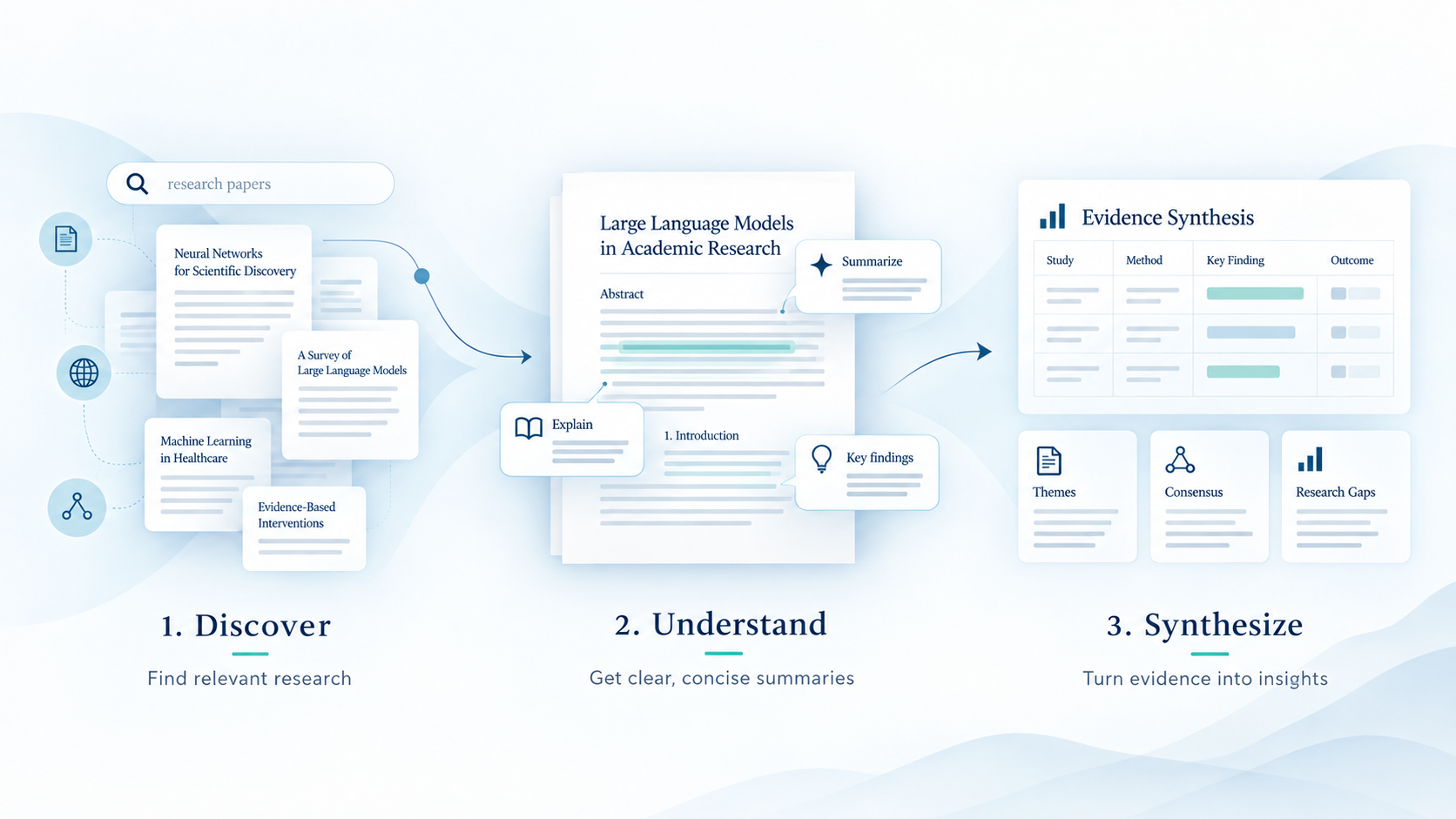
A useful tool should do more than compress a paper into fewer words. The real objective is to reduce reading and research friction while keeping enough context to understand what the study asked, how it was conducted, what it found and where the evidence is limited.
Preserve research structure
Keep the research question, methods, findings and limitations visible instead of reducing a study to one polished conclusion.
Let you interrogate the source
Questions about methods, terminology and assumptions are often more useful than a one-click summary.
Keep claims connected to evidence
For professional or academic work, important claims should remain traceable to the underlying papers.
AI research tools at a glance
These products increasingly overlap, but they still have different centers of gravity in a research workflow.
| Tool | Best for | Choose it when | Main limitation |
|---|---|---|---|
|
SciSpace
Hands-on tested
|
Scholarly discovery and paper-level research Best for exploring literature | You want to find, inspect and work through academic literature in one research-focused environment. | AI-generated synthesis still requires verification against the underlying studies. |
|
Elicit
Hands-on tested
|
Structured evidence synthesis Best for evidence tables | You need to search, screen, extract and compare evidence across multiple studies. | More specialized than necessary if your task is simply understanding one paper. |
Scholarcy |
Fast structured summaries | You want a quick overview before deciding whether a paper deserves deeper reading. | Compression can remove nuance that matters to interpretation. |
Gemini Notebook |
Source-grounded research workspace | You want to question and connect a controlled collection of papers, reports, webpages and notes. | The quality of the output still depends heavily on the quality and scope of the selected sources. |
Consensus |
Exploring what research says about a question | You want an evidence-focused starting point before moving into individual papers. | Less focused on close reading of one paper than a dedicated paper-analysis workflow. |
Perplexity |
Broader research and source discovery | You need current web information, background research or additional sources around a topic. | Broader than a specialist academic-literature tool. |
Northryn tested SciSpace and Elicit with the same research question and compared discovery breadth, synthesis, counterevidence, structured evidence tables and export workflow. Compare SciSpace vs Elicit →
The tools and where they fit
SciSpace
SciSpace is most useful when academic literature is a recurring part of the job. Its value comes from combining literature search, paper interaction, evidence extraction and broader research workflows inside a research-focused environment.
In Northryn’s current testing, SciSpace showed stronger first-pass discovery breadth than Elicit and retained useful paper-level context, including relevance signals and source details. It is a stronger fit when you want to explore the literature before deciding what deserves deeper synthesis.
Elicit
Elicit is a strong fit when the research problem involves a body of studies rather than one isolated document. Its workflow is particularly useful for searching, screening, extracting structured fields and comparing evidence across papers.
In Northryn’s hands-on comparison, Elicit’s Independent Review was a meaningful differentiator: it challenged the first synthesis, searched explicitly for counterevidence and refined the conclusion rather than simply repeating the initial answer.
Scholarcy
Scholarcy is useful when you want a fast, structured overview of an academic paper or long document before deciding whether it deserves a full read.
Its value is speed and structure rather than deep literature exploration. That makes it more useful for screening and orientation than for replacing careful interpretation of methodology or limitations.
Gemini Notebook
Google renamed NotebookLM to Gemini Notebook in July 2026. It remains a standalone research product centered on working with selected sources, while becoming more integrated with the wider Gemini ecosystem.
It is a good fit when your research already lives in a controlled collection of papers, reports, webpages and notes and you want to question, connect and synthesize those materials without constantly leaving the source set.
Consensus
Consensus is useful when your starting point is a research question and you want an evidence-focused view of what academic literature says before moving into individual papers.
Its role is therefore broader than summarizing one PDF, but narrower than general web research.
Perplexity
Perplexity is useful for current web research, background information and broader source discovery around a topic. It fits around an academic workflow rather than replacing a specialist literature tool.
How to Choose
Choose the tool that matches the stage of research
There is little value in trying to identify one universal winner. Start with the research problem you actually need to solve.
The tool matters less than the research workflow
AI research tools are most useful when they sit inside a process that keeps important findings traceable and preserves enough context to evaluate the evidence.
A simple research-paper workflow
Start by identifying the research question and reading the abstract. Use AI to clarify terminology, inspect methodology, extract findings and surface limitations. Then return to the original paper to verify any claim you intend to cite, report or use in a decision.
When several studies are involved, keep each source separate first. Compare study design, sample, outcomes, findings and limitations before asking AI for a higher-level synthesis.
Frequently asked questions
What is the best AI tool for summarizing research papers?
For paper-level academic research, SciSpace is Northryn’s strongest starting point in this guide. If the job is structured evidence synthesis across many studies, Elicit is the better fit.
Is SciSpace better than Elicit?
Not universally. Northryn’s hands-on testing found SciSpace stronger for broader scholarly discovery and paper-level exploration, while Elicit was stronger for structured evidence synthesis, independent review and reusable evidence tables. Read the full SciSpace vs Elicit comparison →
Can AI summaries replace reading the original research paper?
No. AI can reduce reading friction and help identify the sections that deserve attention, but methodology, limitations, numerical findings and claims you intend to use should be checked against the original source.
What is Gemini Notebook?
Gemini Notebook is the current name for Google’s NotebookLM research product. It is designed around working with a defined collection of sources and is useful when you want source-grounded questions, synthesis and analysis across your own research materials.
Should I use Consensus or Perplexity for academic research?
Consensus is more directly focused on exploring academic evidence around a research question. Perplexity is broader and is more useful when you also need current web information, background context and non-academic sources.
Final Takeaway
Use AI to reduce research friction without removing research judgment
SciSpace is the stronger fit when you want to discover and work through academic literature. Elicit becomes more compelling when the job is to structure, challenge and synthesize evidence across multiple studies.
Scholarcy, Gemini Notebook, Consensus and Perplexity solve adjacent problems rather than competing for exactly the same workflow. The best choice is the tool that removes friction from the stage where your research is actually slowing down.
Whichever tool you use, important findings should remain connected to the original research. Faster reading is useful; false confidence is not.
Sources and methodology
- Hands-on evidence: Northryn’s SciSpace review and SciSpace vs Elicit comparison, including comparable research-task testing completed in September 2026.
- Official product information: SciSpace Literature Review and Help Center, Elicit systematic-review documentation, and Google’s July 2026 Gemini Notebook announcement.
- Editorial assessment: Recommendations about workflow fit, which tool to choose and which users should skip a product are Northryn’s interpretation of the tested evidence and current official product information.
- Not claimed as equivalent testing: Scholarcy, Gemini Notebook, Consensus and Perplexity were not subjected to the same side-by-side test used for SciSpace and Elicit for this update.